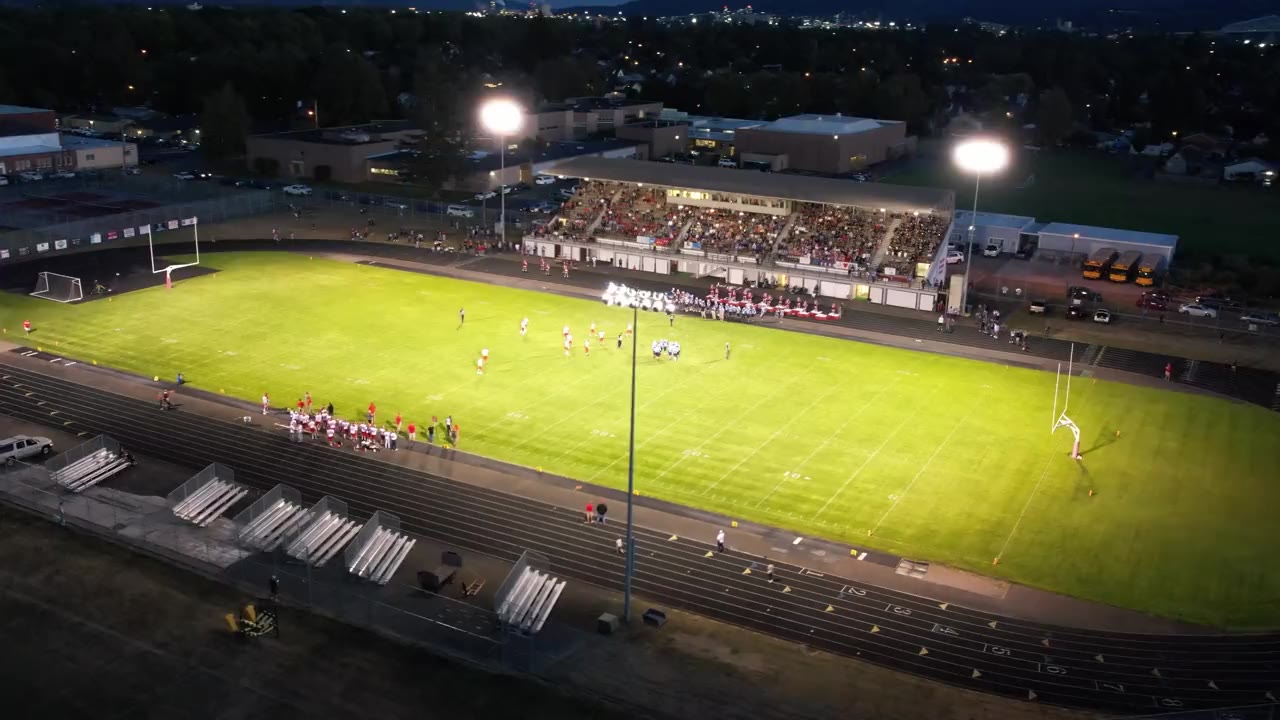
Opponent scouting for high school football
A scouting report in a coach's head doesn't play a down.
One Hudl export. The tendencies that survive a significance test — on both call sheets, in your practice script, and in your players' hands by Monday.
$99 once. Every coach, both sides of the ball, every player.
Trips right, back away from strength → run to the trips side
3rd & 7+ in the red zone → run
Four snaps. The true rate could be 30% or it could be 95%. This does not go on your sheet.
The trust block
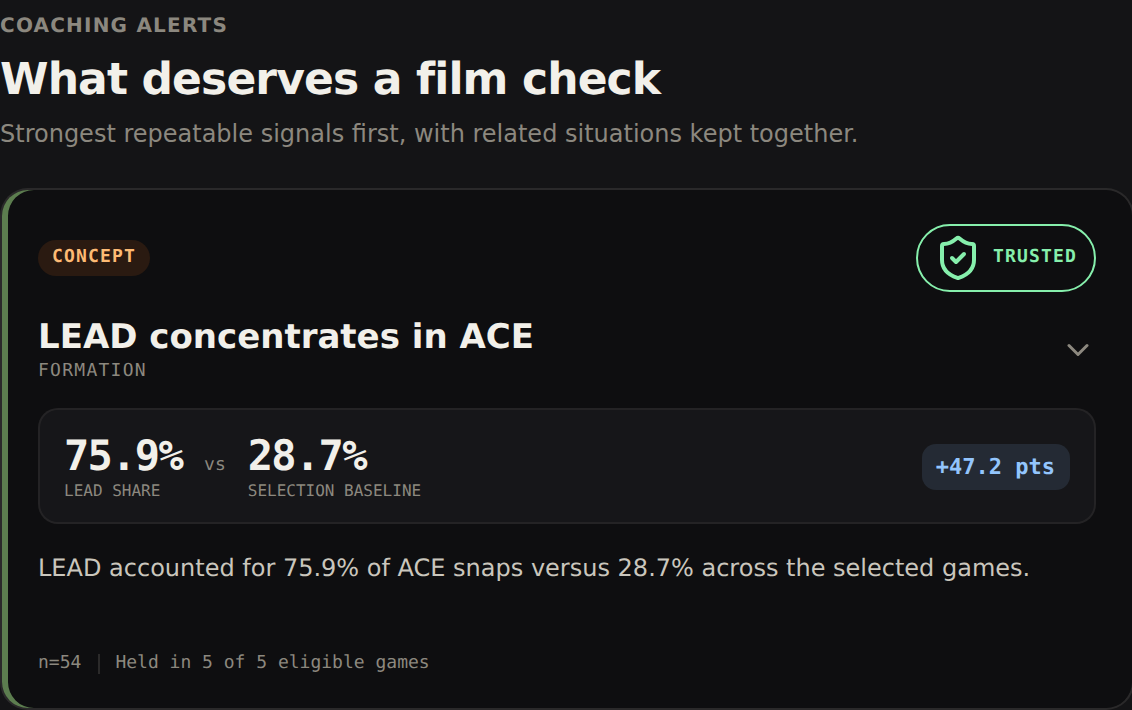
Four of the tendencies on your call sheet aren't real.
Every breakdown tool will hand your staff a number. Almost none of them will say whether to believe it. That's how a Thursday install gets built around four snaps in a blowout.
A percentage with no context
Filter to 3rd & long, red zone, and the tool cheerfully reports 75% run. It never mentions that it found four plays, or that the true rate could just as easily be 30%.
The same number, plus whether it's real
Same filter, same film. Now the sample size is attached, the confidence interval is attached, and thin samples get flagged before they reach your call sheet.
That 75% tendency is three plays and a coin flip.
This is what makes "seven" defensible rather than a marketing round-down.
What coaches say
"Dude that sh*t is insane"
— Defensive Backs coach, Pomona HS, Arvada, CO
"I'm in and this sh*t is sick!"
— Defensive Line coach, Pomona HS, Arvada, CO
How the week runs
Sunday's film becomes Friday's reflex.
One import, five days, three groups of people who all need different things out of the same film.
Import
Drop the playlist export. Games split themselves. Missing columns get named, not guessed.
Screen
Eight views, every number carrying its sample size. What clears the floors is the short list.
Install & rep it
Coaches add the tells film study caught. Scout team gets a rep sheet weighted to what the opponent actually runs.
Players
Short spaced quizzes off the approved tells. You see who is actually preparing.
Call it
A printed call sheet with the surviving tells on it. Works with dead Wi-Fi, in the box.
Tuesday · the scout team
The right looks, at the right volume, in the right order.
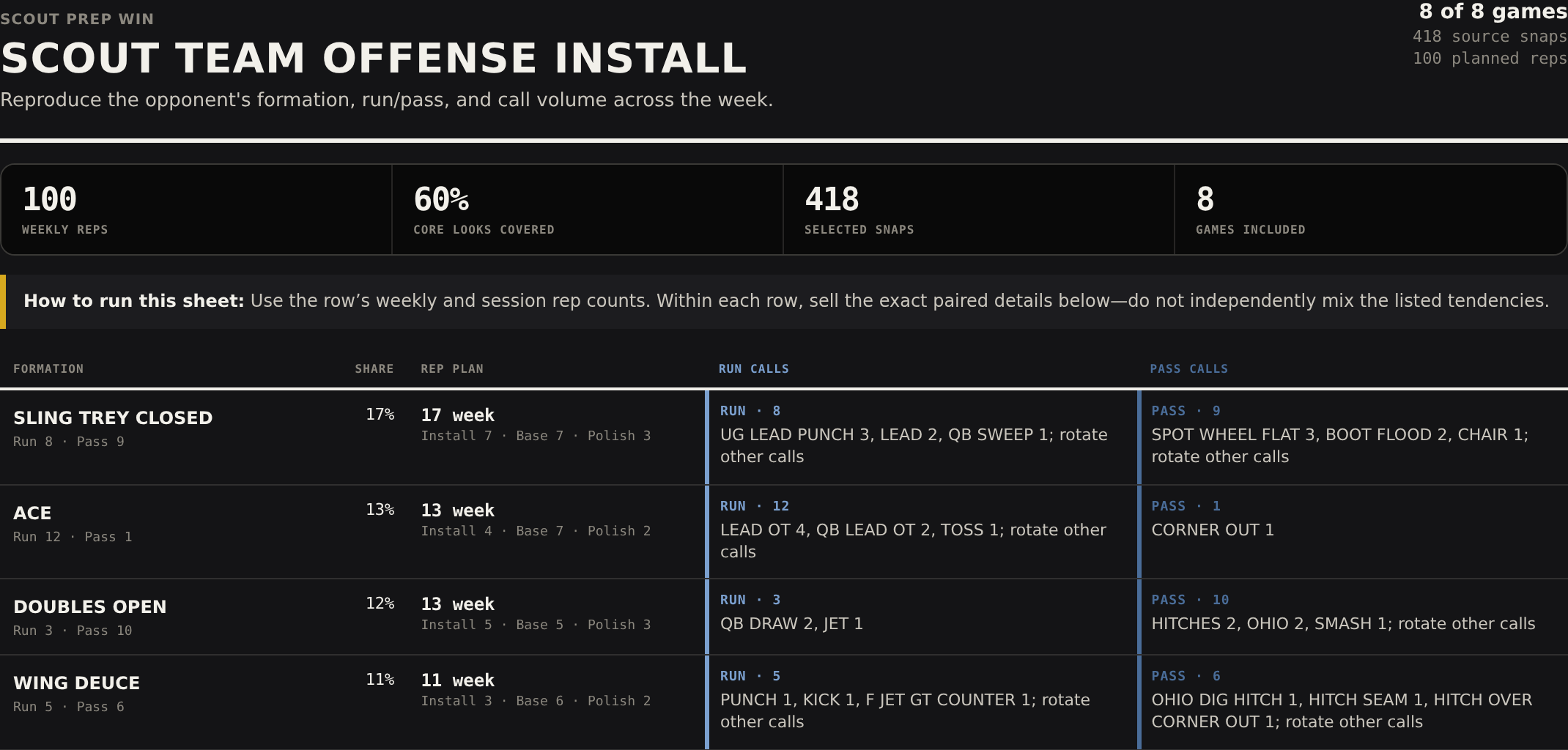
Most scout-team cards get written from memory the night before, so your defense sees the opponent's third-favorite formation as often as their base look — and never sees the situational calls at all. The same breakdown that drives the call sheet drives the rep count.
| Look | Their share | Reps |
|---|---|---|
| Trips right, back awayn=31 · 84% run to trips | 38% | 15 |
| Deuce, TE strongn=44 · balanced | 27% | 11 |
| Empty, late motionn=22 · 3rd down only | 19% | 8 |
| Heavy, goal linen=14 · inside the 5 | 12% | 5 |
| Trick / one-off looksn=3 · below the floor | 4% | 1 |
The card your scout-team coach carries, weighted to the film instead of to whatever everyone remembers from Friday.
Volume, not just presence
If 38% of their snaps come from one look, your defense should see it 38% of the period — not once, and not as often as a formation they ran three times.
Situations get their own reps
Their 3rd-down empty look and their goal-line package aren't base-period problems. The buckets are already in the breakdown, so the periods write themselves.
One list, three jobs
The same surviving tells drive the call sheet, the rep sheet and the player quizzes. Your defense studies, reps and gets tested on the same seven things.
Wednesday and Thursday · the players
It doesn't stop at the coaches.
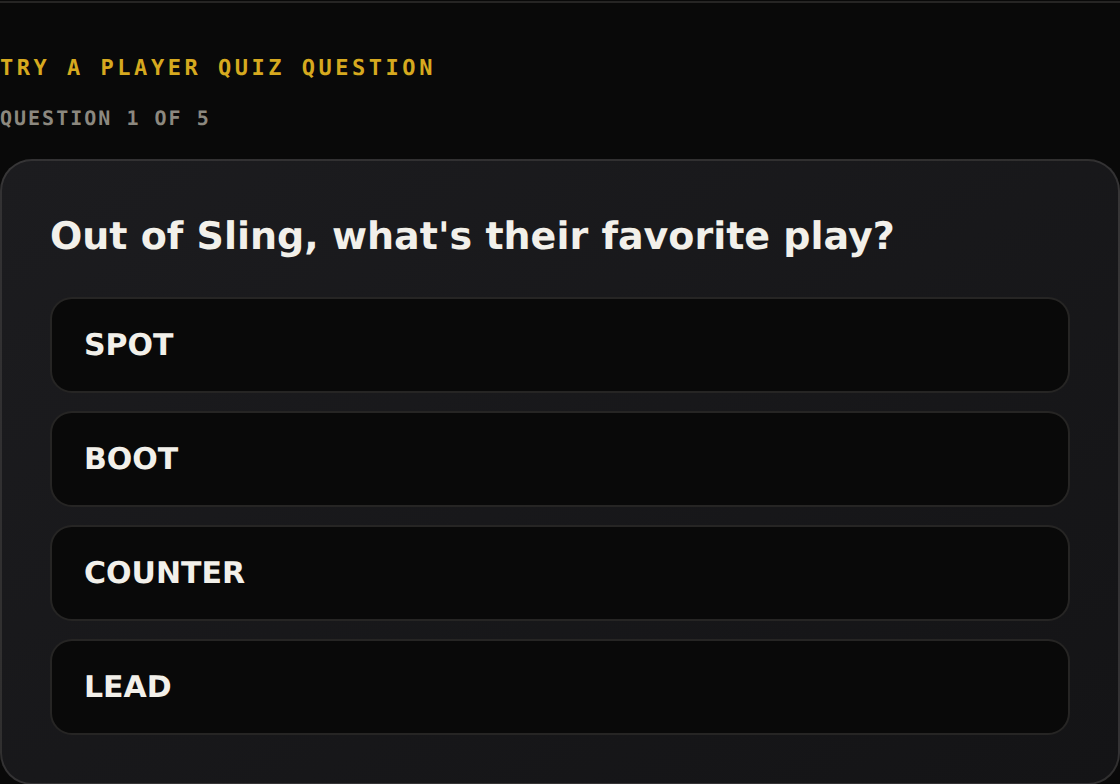
Players scan a QR off the projector and answer their first question in under a minute — no email, no password, no roster entry for you. Short quizzes built from the tendencies you approved, spread Monday through Friday, because repeated retrieval sticks and a Thursday-night info dump does not.
Team completion
74%this week
Touches per tell
4.1Mon–Fri
Most missed
2nd & short from Trips61% wrong
Tuesday · question 2 of 5
2nd & 5, they line up in Trips right with the back away from the strength. What's coming?
The rest of the breakdown
Eight tabs. One import. Whole staff.
Overview
Run/pass, efficiency, explosive rate — plus a panel naming every column your export was missing instead of guessing.
Down & Distance
Every bucket with run/pass, average gain and success rate. Thin buckets flagged, not hidden.
Field Zones
Backed up, open field, fringe, red zone, goal line — with signed yard lines, so "own 15" never reads as "their 15."
Directional
Where the ball goes by formation, strength, hash and motion. Field vs boundary, strong vs weak, Balanced kept honest.
Concepts
Your own editable taxonomy rolls raw Hudl play calls into families. Edit once, every coach's rollups update.
Formation Drift
What they showed in Week 1 versus what they're showing now. Catches the team that installed something after a loss.
Call Sheet
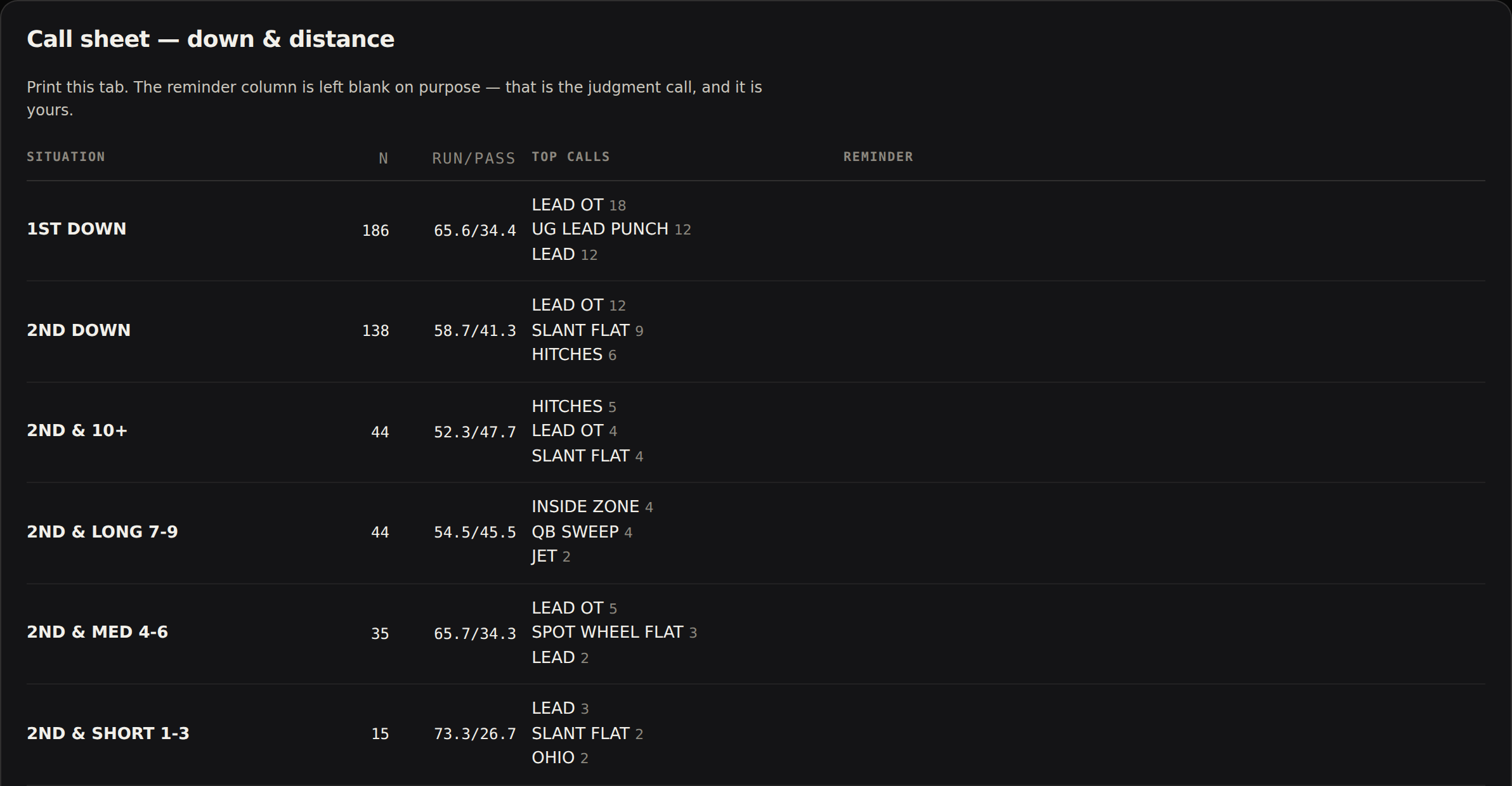
A printable sheet built from the breakdown with your active tells on it, ready for Friday.
Export
Copy out a written analyst brief for the install meeting, or paste it into whatever your staff already uses.
Defensive breakdowns land in-season and are included. The $99 you pay in August covers them in October.
Per staff
Every coach on the staff and every player on the roster. No seat count, no tiers, no add-ons. Not a subscription — football is seasonal and recurring billing through eight dead months is a bad deal for you.
- Your first game is free. Import real film, get the real report, decide after.
- Unlimited opponents and games for 12 months
- Self-scout included — same tool, your own offense
- Scout-team rep sheets and player quizzes at no extra cost
- Nothing auto-renews. No card on file, no dunning email in June.
- 30-day refund, no questions asked
When the 12 months are up your account goes read-only, not dark. Every scout, game and tell your staff wrote stays viewable — you just can't import new film until you buy another year.
This is not a budget conversation
A high school Hudl subscription runs roughly $1,500–$4,000 a year. $99 for a season is two to six percent of what your program already spends on film. It fits on a booster check or a coach's own card.
One list, all week
Seven tells that survived a significance test, a rep sheet weighted to them, quizzes built on them, and a one-page call sheet carrying them into Friday.
The ones coaches actually ask.
Why not just use Hudl's tendency reports?
What data do you actually see?
What about my players' information?
My whole staff needs access. What does that cost?
Does it work on an iPad, with no signal?
Can I scout defense?
Run last Friday's film through it tonight.
If the numbers are wrong you'll know in ninety seconds and it cost you nothing. If they're right, your staff, your scout team and your starters spend next week on a shorter and more honest list.
"Run last Friday's film through this. It tells you which tendencies are real and which are four snaps and a coin flip."